Under The Crow’s Eye: The Unsolved Murders At Fort Worden

An Unsettling Discovery

The trail along Crows Nest Bluff had been dangerous for years. Locals knew it. The Army knew it. In places the path ran within a few feet of the edge, where the bluff dropped two hundred feet to the beach below, the last hundred and eighty of it sheer. Dense brush crowded both sides. On a clear day you could see across the water. On a February morning in 1910, you could see very little.
Coroner Dalgardino and Sheriff McInnes were notified on a Thursday. The body of a soldier had been found on the beach between the city park and Fort Worden, partially concealed in the brush at the base of the bluff. They proceeded to the scene and made a careful examination. The deceased was lying where he had come to rest, some distance below the point where his overcoat had caught in the bushes above, snagged on the way down, dangling in the cold winds. His pockets contained thirty-five cents.
The coroner determined that an inquest was unnecessary. The cause was plain enough: a fall from the bluff to the beach below, a distance of more than one hundred feet. The matter was reported to the officers at Fort Worden, and as the body was not on the military base, the coroner was notified before it was removed.
The deceased was Private Robert B. Dumm, 108th Company, Coast Artillery. He was twenty-four years old. He had two months left to serve.
Unrealized Plans

Robert B. Dumm was not the kind of man who disappears.
He was twenty-four years old, born October 13th, 1885, in Hamilton, Missouri. He had enlisted three years earlier at Columbus Barracks, Ohio, and been assigned to the 108th Company of the Coast Artillery at Fort Worden. By all accounts he was a good soldier. His superiors said so. His Army buddies said so. He had served his time without incident and was, by February of 1910, within two months of an honorable discharge.
He had plans.
Shortly before his disappearance, Dumm had received a draft for $350, a rent payment on property he owned back in Missouri. He didn’t keep the money long. He used part of it to make a payment on some land he had purchased nearby. A place he intended to move his parents (Israel and Cora) out to when his enlistment expired. He was building something: a life after the Army, in the place where he had served.
His military buddies knew about his plans. The man later placed under suspicion of Dumm’s murder knew about it too.
When Robert’s body was found on the beach below Crows Nest Bluff, his pockets contained thirty-five cents.
No Inquiry

The coroner’s certificate was filed on February 21st, 1910. The cause of death was recorded as subdural hemorrhage from rupture of the middle meningeal artery, with laceration of brain tissue. Secondary to a fall from a bluff. The matter was settled, administratively speaking, within days. No inquest was held. The body was shipped home to Missouri on February 19th. The county was spared the expense.
But the men of the 108th Company were not satisfied with that explanation. Neither were their officers.
Dumm’s skull told a different story. Physicians who examined Dumm noted that it showed signs of a blow sufficient to cause death. That was consistent, in the view of those who knew him, with being struck from behind with a slung-shot, robbed, and thrown over the edge of the bluff. The overcoat caught in the bushes above the body had not been on his person when he fell. It had to be removed before. The thirty-five cents in his pockets represented the entirety of what remained of a man who had recently received three hundred and fifty dollars and needed to save it, not spend it at a local bar.
Both military and civil authorities opened investigations. Fifty witnesses were questioned. The officers conducting the inquiry were reticent with the press, advancing no official theory. But their actions said enough. They were not looking for a man who had lost his footing on a dangerous trail. They were looking for whoever had been with him that night.
There was, it turned out, such a person. A man known to have been in Dumm’s company the evening before his disappearance had been arrested and placed in the general guardhouse. He had been questioned. He had told several different stories.
His name was Private Wiley Bennett, of the 106th Company.
A Grim Pattern

Dumm was not the first.
In the eighteen months preceding his death, soldiers had been disappearing from Fort Worden with a regularity that the Army had chosen, officially, to explain as desertion. The pattern was consistent enough to have attracted notice among the soldiers even if it had not yet attracted action from their commanders. A soldier would be present for payday. A few hours later he would be gone. He would not return. His name would be entered in the post rolls as a deserter and the matter would be closed.
The Army had reasons to prefer that explanation. Desertion was a known problem, an administrative nuisance, a thing that happened. Murder was something else. Murder at a federal installation, committed repeatedly and without resolution, was the kind of problem that reflected poorly on the officers responsible for the safety of their men.
But the men themselves did not believe the desertion explanation. They pointed to a detail that the official accounting could not easily absorb: soldiers who intend to desert do not leave their belongings behind. A man going over the hill converts everything he owns to cash first. He does not abandon his kit. He does not leave without preparation. Several of those listed as deserters had done exactly that — left articles behind that they would easily have disposed of, receiving a few dollars in exchange, had they been planning to run.
These men had not been planning to run. The prevailing belief among the artillerymen was that their missing buddies had met foul play on the military reservation, their bodies thrown over the bluff or concealed in the dense brush between the fort and the city, and their disappearances quietly written off in the desertion ledger.
It had happened before. Everyone at Fort Worden knew the name of Corporal Henry Johnson. Approximately eighteen months before Dumm’s body was found on the beach, Johnson had been murdered by a man named James Holt. His remains were found in the furnace of the basement of the band quarters at Fort Worden — burned, deliberately, to conceal the crime. Holt was identified, prosecuted, and removed from the fort.
After that, the disappearances continued.
Undesirables

In the summer of 1909, Seattle hosted the Alaska-Yukon-Pacific Exposition (AYP). It was the city’s coming-out party, a world’s fair built on the grounds of the University of Washington, drawing hundreds of thousands of visitors from across the country and abroad. It was also, by contemporary accounts, a magnet for a certain kind of opportunist.
The men who came to Seattle to prey on the exposition’s crowds were not subtle about it. They were known to the police. They were known to the detectives. When the city’s tolerance for their presence ran out they were told, in the language of the era, to move on. Some of them did. Others found a more creative solution.
They walked into the recruiting station and enlisted.
This was not speculation. It was reported at the time, in the weeks following Dumm’s death, by officers at Fort Worden who had been piecing together what they knew about the men under their command. The theory held that a number of these men, desperate, predatory, already practiced in the business of separating people from their money by force, had been assigned to Fort Worden following the exposition. They arrived at a posting that offered a reliable supply of targets: soldiers paid on a schedule, in cash, walking the same trail between the fort and the city, often at night, often alone, often drunk.
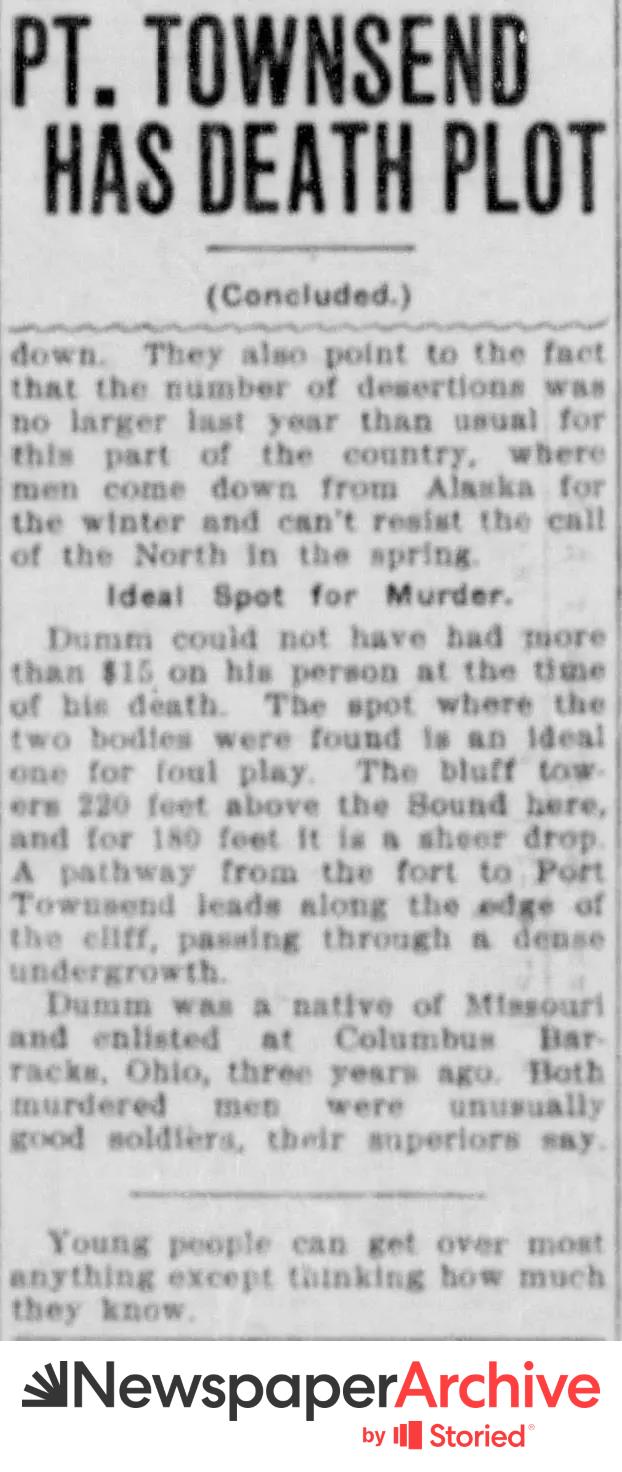
The bluff above Crows Nest Beach was, as one newspaper put it at the time, an ideal spot for murder. Two hundred feet above the water. A sheer drop for the last hundred and eighty. A narrow pathway running along the edge through dense undergrowth, used regularly but seldom in company. A body thrown from the top would land in brush thick enough to conceal it for months. A man entering those records as a deserter would not be searched for.
The exposition closed in October 1909. By February 1910, Robert Dumm was dead.
The Liar

The investigation moved quickly, at least at first.
Fifty witnesses were examined in the days following the discovery of Dumm’s body. The movements of the dead man and those known to have been with him on the night of his disappearance were traced as carefully as the evidence would allow. Officers at the fort were vigorous in their pursuit, but didn’t speak with the press. They were, according to contemporary reporting, weaving a tight web around their primary suspect. They believed they had their man.
Private Wiley Bennett of the 106th Company had been known to be in Dumm’s company the evening before his disappearance. He had known about the $350 draft. He had known that Dumm was carrying money. When questioned, he had told one story. When questioned again, he had told a different one. Placed under oath, he told several more. The officers at Fort Worden concluded that Bennett was constitutionally unable to tell the truth, and that his inability to account for his movements in any consistent way pointed strongly toward his guilt.
The circumstantial case against Bennett was, by all accounts, substantial. The military authorities considered it sufficient and offered to turn him over to the civil authorities for trial. Jefferson County Attorney Scott reviewed the evidence carefully and reached a different conclusion. The case was circumstantial. It would not, in his judgment, convince a jury. Bringing it to criminal court would impose a heavy expense on the county without securing a conviction. He declined to proceed.
The murder charge was dropped.
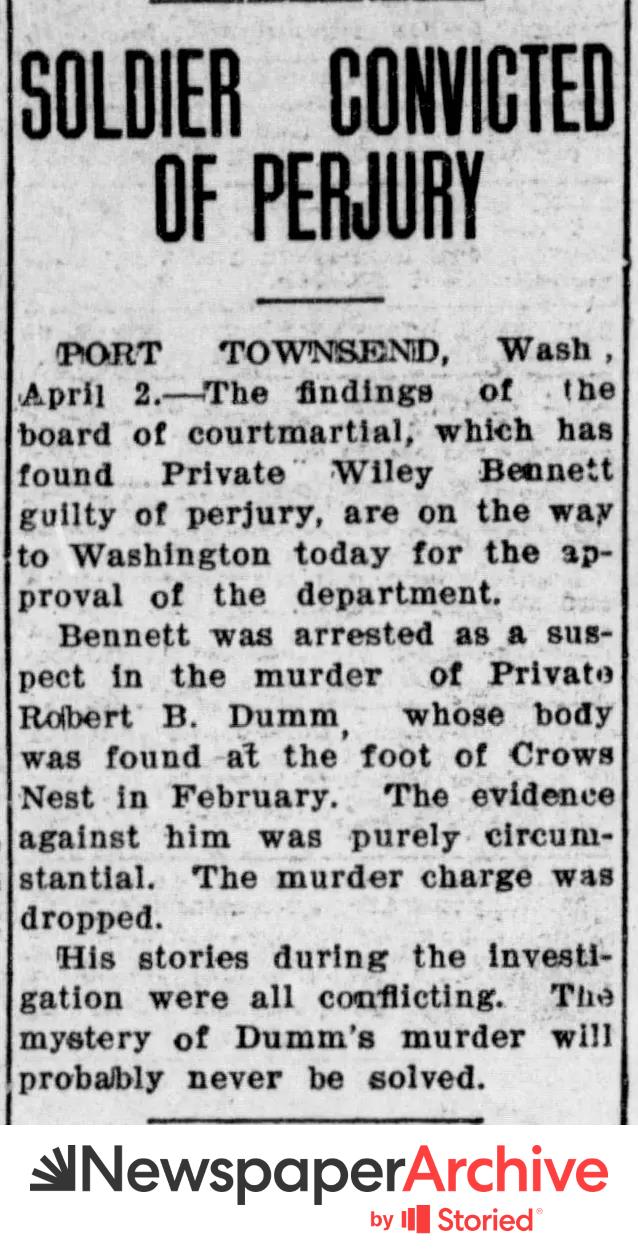
What remained was the lying. Bennett had told conflicting stories under oath, repeatedly, to military investigators. A perjury charge was brought before a board of courtmartial. In April 1910 the board found him guilty. The findings were forwarded to Washington for departmental approval. Bennett would receive, in all probability, the maximum sentence available under military law.
For perjury. Not for murder.
The final word on the case appeared in the Tacoma Times on April 2nd, 1910, in a dispatch from Port Townsend. It was a single sentence, appended almost as an afterthought to the report of Bennett’s conviction: The mystery of Dumm’s murder will probably never be solved.
Nameless

While soldiers searched the brush along the bluff for anything that might help identify Dumm’s killer, they found something else.
Thirty feet from where Dumm’s body had been discovered, partially hidden in the thick undergrowth that grew along the base of the bluff, lay the remains of another man. He had been there considerably longer. The flesh had decomposed and fallen from the bones. The uniform was in fair condition, given the time it had been exposed to the elements, but the pockets had been stripped of every article. There was nothing to identify him. The only hope, investigators noted, was a laundry mark on the clothing — soldiers kept private marks on their gear — but whether that mark was ever matched to a name is not recorded in any account that survives.
Coroner Dalgardino was called to the scene a second time. He viewed the remains and concluded, as he had with Dumm, that an inquest was unnecessary. The Fort Worden ambulance conveyed the body to the post. Every effort was made to establish an identity.
The circumstantial evidence pointed toward a specific man. The hair and facial bones, according to reporting at the time, corresponded exactly with the record kept for a soldier named Reil — Private Reil, who had disappeared approximately a year earlier and been carried on the post rolls as a deserter. He had vanished, as others had, within a few hours of payday. He had not been heard from since.
The body found thirty feet from Dumm had apparently been lying in that brush for the better part of a year. Thirty feet from what would later become a second murder scene. In a location, investigators noted, that was seldom traveled by either soldiers or civilians.
Two bodies. The same bluff. The same stripped pockets. The same official silence.
The artillerymen at Fort Worden had been right. Some of the men on the deserter rolls had not deserted at all.
Under The Crow’s Eye

What happened at Fort Worden between 1908 and 1910 does not have an official name. The army closed its files on the individual cases as they arose — desertion, accidental death, cause unknown — and never formally connected them into a pattern. The newspapers came close, using phrases like “wholesale murders” and “systematic crimes,” but the investigation stalled with Bennett’s perjury conviction and the story moved on.
What the evidence suggests, taken together, is something more organized than a series of isolated robberies.
Consider the operational consistency. The victims were selected on or near payday, when they could be reliably expected to be carrying cash. They were targeted on a specific route — the trail along Crows Nest Bluff between the fort and the city — that offered concealment, a natural disposal site, and low foot traffic after dark. The bodies, when found, had been stripped of every article of value and positioned in the brush below the bluff, where decomposition and weather could do the work of erasure. The men were then absorbed into the desertion ledger, a category that discouraged active searching and provided institutional cover, whether by design or convenience.
This is not the signature of spontaneous violence. It is the signature of a method.
The method predates Dumm. It predates the AYP Exposition. It is present, in embryonic form, in the murder of Corporal Henry Johnson in 1908 — a crime committed inside the fort itself, the body burned in the band quarters furnace to prevent identification, by a man named Holt who understood that concealment was as important as the act. Holt was caught. Holt went to prison. The disappearances along the bluff, which had been occurring with regularity through 1908 and 1909, continued after his removal — suggesting either that Holt had associates who carried on independently, or that the pattern was already established enough that others recognized and exploited it.
The AYP Exposition of 1909 may have introduced new personnel into that pattern. Men already practiced in predatory crime, assigned to a posting that had, over the preceding year, demonstrated the viability of a very specific kind of murder. Whether they arrived to find an existing operation or simply recognized a proven opportunity is impossible to determine from the surviving record.
What is possible to determine is this: the disappearances stopped. Bennett was arrested. The investigation, however imperfect, disrupted whatever had been operating along that trail. The names on the deserter rolls stopped accumulating. The brush below Crows Nest Bluff stopped producing bodies.
Thirty soldiers. Perhaps more. Listed as deserters, filed away, never searched for. The army’s official accounting requires us to believe that an unusual number of men chose to abandon honorable discharges they were weeks or months from receiving, leaving their belongings behind, never contacting their families, never surfacing anywhere in the subsequent record.
That is not a reasonable conclusion. It is an administrative convenience.
The murders at Fort Worden were not solved. Wiley Bennett lied under oath and received a military sentence for it. The man or men responsible for Robert Dumm’s death, for the death of the soldier whose remains were found thirty feet away, for the fate of the others whose names appear on the deserter rolls, were never formally identified and never prosecuted. The case was closed by attrition — Bennett punished for what could be proven, the rest quietly buried under a classification that asked no further questions.
The crow’s eye saw all of it. The record, such as it is, has been waiting for someone to look.
History’s Voice

Fort Worden is a state park now. The gun batteries are open to visitors. The officers’ quarters rent as vacation cottages. Families walk the beach on summer afternoons, and the Bluff Trail, that same trail that ran along the edge of Crows Nest above a two hundred foot drop, is maintained and marked. The undergrowth has been cleared in places. The path is no longer what it was in 1910.
But the beach below the bluff has a different reputation after dark.
Reports of ghostly activity along the Fort Worden waterfront have accumulated for decades. Visitors describe figures on the beach that do not behave like campers: present at the periphery, gone when approached. Cold spots in locations with no obvious environmental explanation. A persistent unease in the brush below the bluff, the particular quality of discomfort that people describe when they can’t identify what’s wrong but are certain that something is.
These reports are difficult to evaluate in isolation. Fort Worden has a documented history of paranormal activity unconnected to the bluff: its buildings, the batteries, and underground passages have all generated accounts over the years. And the site carries the atmospheric weight of a place that housed men trained to kill. Distinguishing one layer of history from another, in a location this saturated with ghost stories, is not straightforward work.
But the beach below Crows Nest is specific. The spectral reports cluster there consistently. And the history of that particular stretch of shoreline, with bodies concealed in the brush, men stripped of everything they carried, deaths recorded as accidents or desertions and quietly filed away … it provides a context that most visitors walking that windy beach on a sunny afternoon don’t know about.
They are walking through what was for at least eighteen months a reliable killing ground. The bluff above them is where the path ran in the dark, where men carrying a week’s pay made their way back to the fort, where someone (more likely a group) was waiting.
Farewell Robert

The Tacoma Times gave the case its epitaph in April of 1910, and the epitaph has held for more than a century: the mystery of Dumm’s murder will probably never be solved.
That is likely true, in the strict legal sense. The men responsible are long dead. The evidence that existed in 1910 — the witnesses, the physical record, whatever Bennett knew and refused to say clearly — is gone. There will be no prosecution. There will be no conviction. The Jefferson County Attorney made his calculation and closed the door, and no one has opened it since.
But unsolved is not the same as unknowable.
The record that survives — the death certificate that says one thing and the skull that said another, the stripped pockets, the overcoat caught in the brush above the body, the second set of remains thirty feet away, the fifty witnesses and the conflicting stories and the perjury conviction that substituted for justice — that record is coherent. It points in a direction. It describes a pattern that operated for eighteen months on the trail between Fort Worden and Port Townsend, that consumed somewhere between two and thirty men depending on how seriously you take the desertion rolls, and that stopped when the investigation, however inadequate, disrupted it.
Private Robert B. Dumm was twenty-four years old. He was from Hamilton, Missouri. He had purchased land in Jefferson County and was planning to bring his parents west when his enlistment expired in two months. He was struck on the head, robbed of everything he carried, and thrown from the bluff to the beach below. His death was recorded as a fall. His killer was never charged.
The soldier found thirty feet away has no name in the surviving record. He had been lying in the brush for the better part of a year when they found him, close enough to hear the water. His pockets were empty. His uniform held a laundry mark that may or may not have led anywhere. He is listed, somewhere in the Fort Worden records, as a deserter.
They were not deserters. They were not accidents. They were men who walked a dangerous trail in the dark and met something worse than the drop.
The bluff is still there. It has a new name, Artillery Hill. The beach is still there. The trail Robert and nearly 30 other murdered soldiers walked, still there. The brush grows thick along the base where the bodies were found, thirty feet apart, stripped and left to the elements while the army filed the paperwork and moved on.
But history has a way of reminding us. It might be ghosts. It might be someone following up on a long buried lead. Yet, someone always takes a look back in time … and raises their voice.
Sources



Newspaper Archives
“Death of Robert B. Dumm Shrouded in Mystery.” Port Townsend Leader, February 1910.
“Falls From Crows Nest Bluff: Remains of Private Robert B. Dumm Found Yesterday.” Port Townsend Leader, February 1910.
“Fort Worden Murder Mystery Being Probed: Officers are Working Industriously on the Case.” Port Townsend Leader, February 1910.
“Dead Body Found Under the Bluff: Another Mystery to Be Unraveled by the Authorities.” Port Townsend Leader, February 1910.
“Pt. Townsend Has Murder Pact at Fort: Two Soldiers Mysteriously Killed.” Seattle Star, February 28, 1910, p. 1.
“Pt. Townsend Has Death Plot.” Seattle Star, February 28, 1910, p. 8.
“Washington News Stated in Brief: Soldiers Thought Slain.” Newport Miner, March 3, 1910, p. 11.
“Soldier Convicted of Perjury.” Tacoma Times, April 2, 1910, p. 8.
Public Records
Certificate of Death, Robert B. Dumm. Washington State Board of Health, Bureau of Vital Statistics. Record No. 6, File No. 1511. Filed February 21, 1910. Jefferson County, Washington.
Have you been to Fort Worden and experienced a ghostly encounter? If so, tell me about it in the comments. Thanks for reading Ghostly Activities. Much appreciated and take care!