

The Krampus Wreath: Folklore or Holiday Marketing?

A wreath meant to keep Krampus away sounds like exactly the kind of thing you’d hang on the door before December 5 (Krampusnacht, the start of Deep Bleak). But I went looking for its folklore roots, and I couldn’t find evidence that a Krampus wreath was a traditional Alpine charm.
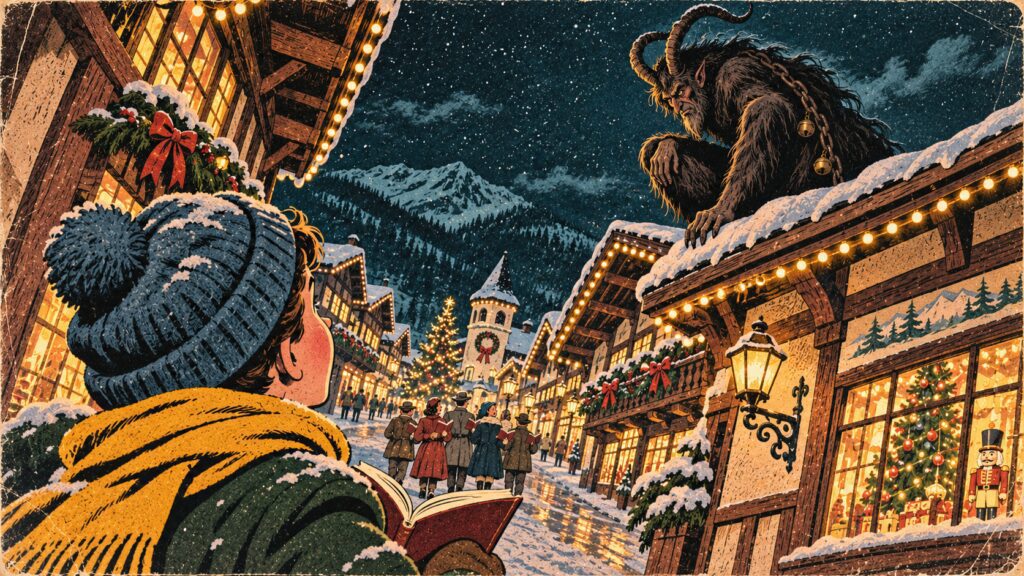
What I did find is a wreath-related twist. In Austria, Krampuskränzchen refers to a social event where Krampus performers visit pubs and other venues. Here, Kränzchen means a gathering, not a wreath hung up to repel spirits.
So if you’ve seen a “Krampus wreath” for sale, it may be a modern decoration or a translation mix-up. That doesn’t make it a bad craft project. It just means the old folklore connection is hard to verify.
What Krampus tradition does tell us

Krampus is part of Alpine Advent customs, often appearing alongside Saint Nicholas around December 5. In traditional visits, Nicholas rewarded well-behaved children while Krampus frightened or punished the naughty ones.
Krampus runs and other local customs grew around the figure, with details varying by region. The exact origins are uncertain. Claims that Krampus is definitely an ancient pagan spirit are often repeated, but the surviving evidence doesn’t establish that.
There is a related winter custom with a clearer spirit-chasing connection: Perchten processions. The Austrian National Library notes that a 1582 account describes a Perchten hunt intended to drive away winter’s evil spirits.
What the event actually looked like isn’t known, and Perchten aren’t simply another name for Krampus. Some of the customs overlap, but they belong to different traditions.
Could a wreath still fit the season?

Sure. Evergreen plants stay green through the cold months, so they make a natural symbol of life holding on through winter.
The Advent wreath also carries Christian meanings of light and eternal life. Its documented history points to a candle arrangement created by Johann Hinrich Wichern in Hamburg in 1839; the familiar evergreen wreath developed later.
That gives us useful winter symbolism, but it doesn’t prove that an evergreen wreath was used to keep Krampus or other spirits away.
Make a folklore-inspired Krampus wreath
If you want one for the front door, make it your own seasonal interpretation. Check out the video above for a very detailed process. In a nutshell, here’s how to make one:
- Start with a grapevine or wire wreath form
- Add evergreen branches and pinecones
- Work in a small bell, chain detail, or birch twigs as nods to Krampus costumes
- Add horns or a mask motif if you want the full look
Note: Traditional costumes often include bells, chains, fur, and a carved mask.
So, I’d call it a Krampus-inspired winter wreath, not an old protective ward. You can buy one because it looks good, make one because it’s fun, or decide it wards off whatever’s rattling its chains outside.
Folklore gives us a creepy season and plenty of symbols to play with. It just doesn’t give us solid evidence that this particular wreath keeps Krampus away.
References
Austrian National Library, “Auf Teufel komm raus! Der Krampusbrauch in Österreich” — Regional Krampus customs, the meaning of Krampuskränzchen, Perchten traditions, and the limits of what historical sources tell us.
Library of Congress, “Krampus: Origins and Development of a Winter Devil” — Krampus’s documented history and a useful caution about claims of ancient pagan origins.
SalzburgerLand, “Krampus and Perchten” — Regional descriptions of Krampus costumes, runs, and the distinction between Krampus and Perchten.
Christ the King Church, “What Is an Advent Wreath?” — Wichern’s 1839 candle arrangement and the later development of the familiar Advent wreath.
American Bible Society, “The Advent Wreath” — Common Christian symbolism associated with the wreath’s circle, evergreens, and candles.
I’m going to hang a few Krampus ornaments this holiday (or is it bleak) season. For sure, I will use the Krampus bell. What about you? Let me know in the comments below. Thanks for reading Ghostly Activities. Much appreciated and take care!


