Evidence Types For Ghost Hunters

Ghost hunters can learn a lot from crime scene investigators. In this post, we’ll take a look at types of evidence (with a ghost hunting twist), and how you can use it to present a better haunted case. Get the scoop after the jump.
Key Takeaways
- Ghost hunting uses a framework similar to crime scene investigations, focusing on different types of evidence.
- The article outlines four evidence types: testimonial, physical, documentary, and digital, along with direct and circumstantial evidence.
- Each evidence type helps shape the understanding of hauntings, reinforcing the need for thorough research and documentation.
- To prioritize evidence for reports, focus on the highest quality tiers while acknowledging lower tiers as personal experiences.
Table of contents
How To Think About Different Types Of Evidence

When I walk into a haunt, I think more like a police detective than a TV ghost hunter. My mind goes into a review of witness interviews, haunting reports, previously captured evidence … really, ghost hunting uses a similar framework as crime scene investigations. It’s like you open a cold case file, based on dark history and witness reports, and try to figure out how to solve it. And that’s why you need evidence.
So, in this post, you’ll see how ghost hunting evidence and crime scene evidence correlate. And, as a cozy ghost hunter and ghostly gumshoe, it helps me organize my case files.
Now, we’ll have to take some liberties with a police detective’s evidence classifications to make them useful for ghost hunting.
Here are the 4 types of evidence and 2 umbrella terms in a handy-dandy table you can use:
| Evidence Type | Crime Version | Ghost Hunting Version |
|---|---|---|
| Testimonial | Witness statements, interviews & confessions | Witness statements, other teams’ reports & your experience |
| Physical | Weapons, fingerprints, DNA | Objects move, mysterious imprints, doors opening/closing |
| Documentary | Emails, texts, contracts | Archives, obituaries, newspaper clippings |
| Digital | CCTV, phone GPS, keycard logs | EVP, infrared video, photo anomalies, EMF spikes |
| Direct | Proves a fact without a doubt | Names or details given during EVP sessions |
| Circumstantial | Infers a fact but requires other types of evidence | Cold spots in a closed room, EMF spikes in room without power |
When it comes to ghost hunting, you’ll capture a lot of circumstantial evidence like EMF spikes, cold spots, ITC communication, and feelings. None of these would prove a ghost is present or identify the spirit, but they could build a stronger case over time. That’s why you should re-visit haunted locations to see if these ghostly activities frequently happen.
Let’s take a look at each evidence type in greater detail.
Ghost Hunting Evidence Types
Testimonial Evidence: Eyewitness Reports & Experiences

When it comes to ghost hunting, testimonial evidence will include client interviews, eyewitness accounts, ghost stories from staff, your experiences, and other ghost hunting teams’ reports.
All these reports give you leads, patterns to spot, haunted hotspots and a timeline. This evidence gives you a better understand of how the haunting affects people. But it also comes with considerations …
Memories are messy, and people forget details as time passes. People will also mix legends, popular culture (like movies), and rumors into their accounts. If they freaked out during a ghostly manifestation, they may hyperbolize what really happened.
So, you have to treat testimonial evidence as a starting point, not final proof. You’ll get clues to setup your experiments and how to document the activity. Unless you can corroborate the details, you need to treat testimonial evidence as hearsay.
Physical Evidence: Physical & Environmental Anomalies

Physical evidence is critical to your credibility. It’s also some of the rarest to capture. Sure, you can capture an EVP and a moving door, but that doesn’t prove a ghost. The holy grail of all evidence is a full-bodied apparition. And I can’t remember the last time someone caught that on camera (especially video) that couldn’t be debunked.
Physical evidence means ghostly activity that you can see and hear. Some examples include:
- Moving objects like doors, windows, coins, cat balls, etc.
- Apparitions and shadow figures manifesting
- EVP directly answering your questions (and you can easily understand it)
Needless to say, those 3 examples are hard to come by, but you can set yourself up for success by doing a baseline walkthrough and debunking.
Tips To Capture Physical Evidence
- Visual evidence: Film at the widest setting on our camera to capture as much of the space as possible
- EVP: Boost the midrange in your audio editor to amplify human voice range and find EVP faster; then stack the clips (at least 3x) to amplify the waveforms to hear the EVP better
- Movement: Mark the testing object (draw a circle for example), then repeat shots (or let the video record continuously) to capture the movement
Documentary Evidence: Ghosts Love Paperwork

Documentary evidence is where those amateur historians get to shine. It focuses on collecting files like:
- Property records
- Death certificates
- Obituaries
- Newspaper reports (the grim stuff like suicide, accidents, crime and worse)
- Photos
- Letters
- Diaries
- Yearbooks
- Travel logs (like a ship’s passenger list)
Now, you still have to find these documents. Luckily, there’s a lot resources available to you. Here are some of the ones I use:
- Newspapers.com
- NewspaperArchive.com
- SmallTownPapers.com
- Ancestry.com (great for death certificates)
- DiedInHouse.com
- FindAGrave.com
- Fold3.com (military records)
- Sanborn fire maps (to find original buildings on lots)
- Library of Congress (newspapers)
- National Archives
And while these resources can tell you a lot, you still want to swing by your library, historical society and local museums. They’ll have more records (including microfiche!) than you could only imagine.
Anyway, you use these files to make a profile of the ghost or haunted place. That profile will help you communicate with the ghost. I mean, you’ll know everything about the ghost, so you can actually have a great conversation with the spirit. You can ask about the ghost’s childhood, home, and other topics to build a connection. And connections are a great way to get answers and verification.
Another thing: All this research lets you separate fact from fiction (a.k.a. urban legends), and set the historic record straight.
Note: I’ll make a post about separating legend from fact soon.
Digital Evidence: The Tech Side Of A Haunting

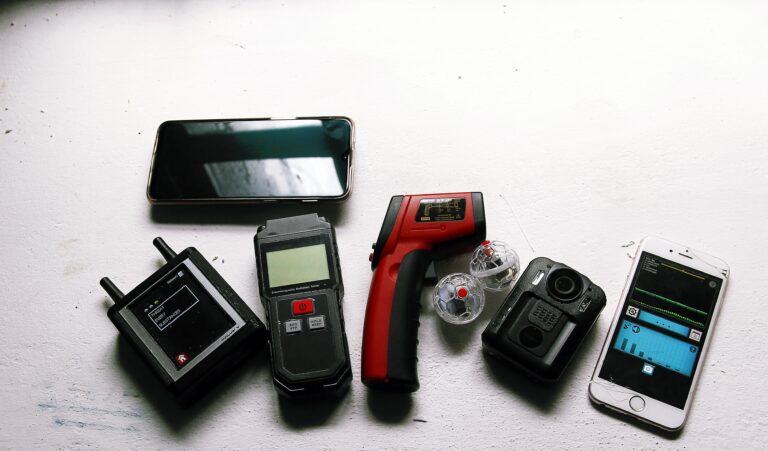
Here we get into the gadgets that collect different data that becomes clues or evidence. To build your haunted case, you’ve got to collect, analyze, debunk and present the best activity. And since you mainly can’t see a ghost walk up to you, gadgets help do that.
I probably keep harping on this, but visual and audio evidence is the best type to collect. That means visual and audio. You might be thinking, “What about EMF spikes, cold spots and motion sensors?!” Well, no one can see or hear EMF. People can’t see the temperature drop without a thermometer. And that motion sensor? Well, you can definitely hear it, but the thing that triggered it is invisible (mostly).
So, it’s important to put visual and audio collecting gadgets at the top of your equipment list. Here’s what you can capture by gadget type:
Audio: EVPs, direct (unseen) voices, footsteps, and knocks.
Video/Photos: shadow figures, light anomalies, and object movement.
Environmental: EMF spikes, temp drops, movement direction and proximity, ion increases, static electricity, humidity, and air pressure.
To collect the best evidence with gadgets, you try to control as much of the area as you can. That means only include people essential to your tests, use your baseline measurements to note anomalies, ask questions based on your documentary evidence, and debunk.
The best evidence you collect with gadgets will align with the haunt’s history and witness reports. But expect something to come out of left field and set you in a new directions. It happens … often.
Parting advice: Really understand how your gadgets work, their weaknesses, their strengths, and how to analyze the data. That will help you present the best evidence for your case.
Direct vs Circumstantial: Can Ghost Evidence Ever Be “Proof”?

Let’s address the elephant in the room: Ghost evidence is hard to capture, and most people won’t believe you when you present it. Your best bet is to capture physical evidence of a ghost, and that’s rare.
Physical evidence falls under (or is as close to) direct evidence. Direct evidence is the most convincing evidence you can present. It will help convince people you found a ghost. Some examples include clear EVP of a name or an apparition recorded on video.
But most ghosts and haunting evidence would be circumstantial evidence. This evidence may not prove you found a ghost, but it builds a case for one. Examples include EMF spikes, heebee jeebies, proximity sensors going off, or taps detected on an Onvoy. None of these examples—by themselves—prove a ghost is present. But if you get all of them happening in a few minutes, it strengthens your case to say some place is haunted.
To be frank, you’re not trying to convince a jury you found a ghost. All you can do is present the evidence that supports your hypothesis as well as the evidence that doesn’t.
How To Prioritize Ghostly Evidence

Now that you’ve got your evidence organized, you prioritize what you’ll present in a report. There are 5 different tiers of evidence quality. For your report, which determines your investigation’s credibility, use evidence from Tiers 1-3. I usually omit Tiers 4 & 5 in my reports, but you don’t have to. Just clearly label that evidence for Tier 4 as a personal experience. As for Tier 5, that may be better suited in your setup and how you collected leads.
Ghostly Evidence Tiers
- Converging evidence
- History, witnesses, and physical evidence all support your hypothesis
- Documented physical and digital anomalies
- Captured in photos, audio, or logs, with time and place
- Consistent testimony from different people
- Similar details without obvious cross-talk
- Single experiences
- Strong for the human story, weak as stand-alone “proof”
- Pure legend and lore
- Great for atmosphere and leads, not enough on its own
Sources
Bukalski, Brendan. “Understanding Different Types of Evidence.” The Intelligencer, 21 Mar. 2017,
www.theintelligencer.com/commentary/article/Understanding-different-types-of-evidence-11017125.php.
Dutelle, Aric W. An Introduction to Crime Scene Investigation. 4th ed., Jones & Bartlett Learning, 2022.
Gehl, Rod, and Darryl Plecas. Introduction to Criminal Investigation: Processes, Practices and Thinking. BCcampus, 2017,
pressbooks.bccampus.ca/criminalinvestigation.
Lee, Henry C., and Howard A. Harris. Physical Evidence in Forensic Science. 3rd ed., Lawyers & Judges Publishing Company, 2011.
“A Simplified Guide to Digital Evidence.” Forensic Science Simplified, National Forensic Science Technology Center, n.d.,
www.forensicsciencesimplified.org/digital/DigitalEvidence.pdf.
“Law 101: Legal Guide for the Forensic Expert – Relevancy of Evidence.” National Institute of Justice, 7 Aug. 2023,
nij.ojp.gov/nij-hosted-online-training-courses/law-101-legal-guide-forensic-expert/trial/relevancy-evidence.
If you haven’t written a ghost hunt report before, you can check my post on that subject.
How do you classify for ghost hunting evidence? Let me know in the comments below.
Thanks for reading Ghostly Activities. Much appreciated and take care!
Discover more from GHOSTLY ACTIVITIES
Subscribe to get the latest posts sent to your email.