

Ghostly Mists: How to Tell Real Fog From a True Anomaly

Some ghost evidence is loud. A door slam. A footstep. A faint voice on tape. The squealing of a REM pod.
Ghostly mist is the opposite. It’s quiet. It’s subtle. It’s not giving you any clues to a spirit’s identity.
But here’s the problem.
Mist is also one of the easiest “ghost signs” to misread. Breath looks like mist. Real fog looks like mist. Dust and moisture near your lens can bloom into a glowing haze, especially on night vision.
So if you want to investigate ghostly mists the right way, here’s a little field guide you can actually use.
What Counts as a “Ghostly Mist,” Anyway?

When investigators say “ghost mist,” they usually mean a mist that feels out of place.
Not just a foggy night.
Not just your breath.
Not just moisture in the air.
They mean a mist that looks like it has intent. Like it moves with purpose. Like it swirls around a spot, or forms a pocket, or rolls through a hallway like it knows where it’s going.
I’m not here to tell you every mist is a spirit. I am here to help you catch the rare clip that proves the phenomena is more than water vapor.
The Four Mist Shapes People Report Most
Think of these as your “mist vocabulary.”
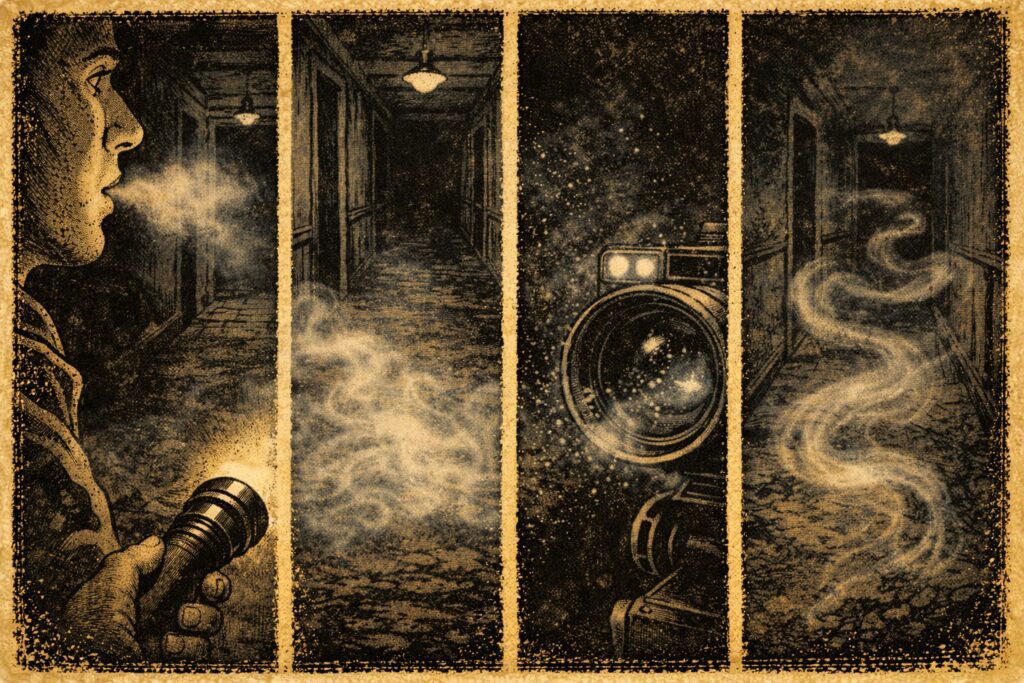
- The Veil: a thin sheet that drifts across frame like gauze.
- The Ribbon: a narrow strand that snakes, curls, or pulls in a direction.
- The Swirl: a twisting pocket that spins in place.
- The Wrap: mist that seems to curl around a person or object.
None of these prove anything on their own. But they give you a vocabulary. And that’s important when you’re logging evidence.
Most “Ghostly” Mists Have Boring Reasons

I’ll be real with you: Most “ghost mist” is normal mist. That’s good news.
Because once you can rule out the normal stuff, the supernatural stuff stands out.
Here are the big three normal reasons for “ghost” mists:
1) Breath
Cold air turns the warm moisture in your breath into tiny water droplets. It looks like a little cloud. It’s basically portable fog. If you’re investigating outdoors in fall or winter, breath is enemy number one.
2) Real Fog
Fog forms when air temperature and dew point get close, so the air is near saturation. In simple terms: the air cannot hold much more water vapor, so water condenses into tiny droplets you can see. (National Weather Service)
A useful rule of thumb from weather training material: fog is more likely when temperature and dew point are within about 5°F (3°C). (National Weather Service)
3) Near-lens particles (backscatter)
Dust. Pollen. Bugs. Moisture droplets. If they’re close to your lens and you’re using an IR light or camera light, they can flare into “ghosty” blobs and foggy haze. That’s called backscatter or near-camera reflection. (SimpliSafe Support Home)
This is why some of the “best” mist videos happen right in front of the camera. Because the camera is the one creating the effect.
The Mist Test (A Field Method You Can Run in 60 Seconds)

When you capture mist, do not decide what it is yet. Run a quick test with this checklist
Step 1: Check the temperature vibe
- Is it cold enough to see breath?
If yes, assume breath first.
Step 2: Check your lighting
- Were you using IR night vision?
- Was a flashlight near the lens?
- Was your phone light on?
If yes, assume backscatter first.
Step 3: Check the weather conditions
- Low ground? Near water? After rain? Late night or dawn?
Fog loves these conditions. Weather training guides describe common fog setups like radiation fog (cooling overnight) and advection fog (moist air moving over colder ground). (National Weather Service)
Bonus: If you can, log temperature and dew point with a weather app. If they’re close (within about 5°F / 3°C), fog is on the menu. (National Weather Service)
Step 4: Watch the behavior
Ask one simple question: Does it behave like airflow?
Normal mist drifts. It thins. It follows wind. It pools in low spots.
The possibly supernatural clips are the ones that:
- hold shape longer than they should
- move against the obvious airflow
- seem to “choose” a path to move along
It’s not proof. Just worth a closer look in the context of the rest of your collected evidence.
Step 5: Look for repeatability
This is huge. If something repeats, then there’s something physical happening:
- Does it show up from another angle?
- Does it show up on a second device?
- Does it show up again in the same spot later?
Repeatability raises credibility.
Mist Looks Like a Ghost When You Want It To (Matrixing and Pareidolia)

Let’s talk about the human brain. It tries to make sense of chaos, so it looks to make patterns it understands. That’s why people see faces in clouds and shapes in shadows (or mists in this case). The phenomenon is called pareidolia, and it’s normal. (PMC)
Mist is basically a pareidolia playground. Swirling black-and-grey colors in a fog AND in a haunted cemetery … my brain goes to ghosts. But that’s usually not the case.
The Ghostly Activities “Matrixing Protocol”
If you think you see a figure or face in the mist, use these steps to verify it’s a natural, or supernatural, cause.
1) Lock the original: Save the raw file. Do not edit first. Not even contrast.
2) Do a cold read: Look at the clip once with one goal: Describe the motion, not the meaning.
Example:
“Soft swirl enters frame left, rises, thins, then stretches toward the doorway.”
Not:
“A woman walks into the hall.”
3) Identify the three classic traps
- Breath: appears in pulses, blooms fast, fades fast.
- Backscatter: glows weirdly, looks close to lens, changes shape fast with tiny movements.
- Real fog: consistent with environment and weather setup.
4) Frame-by-frame consistency: If it’s video, scrub it (or watch frame by frame). Does the “head and shoulders” keep proportion across multiple frames? Or does it collapse into the swirl?
5) The two-witness rule: This is my favorite test.
- Have someone else watch the clip without your interpretation.
- Ask them to describe what they see.
- If they independently point to the same shape in the same moment, that’s more interesting.
If they see something totally different, that’s likely matrixing.
6) Use confidence language: You don’t have to declare a ghost.
Try tiers:
- Possible silhouette
- Consistent silhouette across X seconds
- Consistent across two angles/devices
A Quick Mist Reference Table
Keep this table in your notes. I refer to it often.
| What you captured | Most likely cause | Fast test | What makes it weirder |
|---|---|---|---|
| Mist blooms near camera | Breath or backscatter | Step away, turn off IR/light, wipe lens | Same effect appears from far away too |
| Low rolling ground fog | Normal fog | Check weather, low spots, dew point spread | Fog pools in one odd spot only |
| “Face” appears in swirl | Pareidolia + contrast | Get a second viewer, cold read | Two viewers identify same shape, same timing |
| Ribbon crosses frame | Airflow or insects | Check wind, check for bugs near lens | Ribbon tracks toward a specific object, repeats |
Gear and Camera Tips That Help You Capture Mists
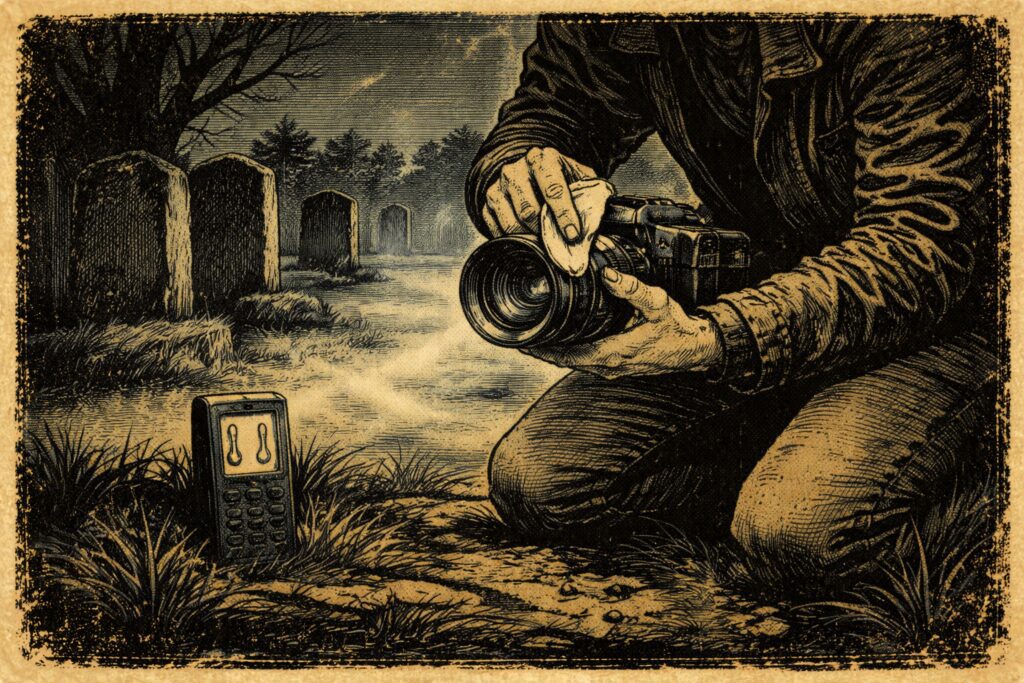
You do not need a professional filming rig to capture a mist. You can use your phone. The big thing is to capture the mist as it exists without any filters or fiddling with settings.
1) Clean your lens often
Mist evidence is fragile. A fingerprint can make your whole night look “haunted.” Wipe the lens. Wipe the housing. Check for moisture.
2) Control your light
If you’re using IR, be aware: the camera is actively lighting the scene with near-infrared illumination, and reflections from particles close to the lens can create foggy artifacts.
Try this simple experiment:
- Film 10 seconds with IR on
- Film 10 seconds with IR off (use ambient light or a light held away from lens)
If the mist vanishes when the lighting changes, it may be an artifact (aka a false positive).
3) Create distance
Mist near the lens seems denser that it is. Plus, you get water particles on your lens, making false positives more common. Mist deeper in the scene is harder to fake. Back up. Change angles. Add a second camera if you can.
4) Log wind and moisture, even loosely
You don’t need a weather station. A cheap hygrometer or a simple note like “still air, damp ground, near creek” helps later. You can also use a weather app with your location to better understand wind direction and humidity.
Fog science is real and predictable. Use that to your advantage. (National Weather Service)
How to Document Ghostly Mist Like a Pro
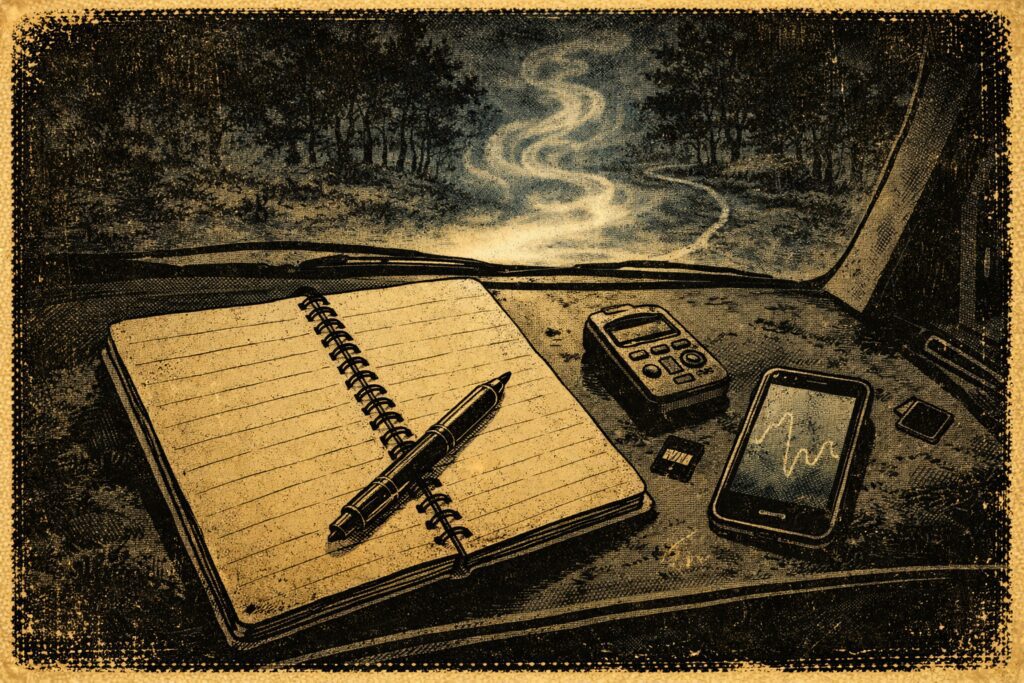
Here’s the workflow I use in the field when I encounter an ectomist.
The Mist Capture Workflow
1) Mark the moment: Call the time out loud on camera or clap once so you can find it in audio later.
2) Film the environment:
- Wide shot for 20 seconds
- Medium shot for 20 seconds
- Close shot for 20 seconds
This gives context. Mist without context is a blurry photo, not evidence.
3) Recreate the conditions: If it might be breath, test it. Step into frame and exhale once on purpose. See what it looks like. If it might be backscatter, test it. Turn IR on and off. Wipe lens. Record again.
4) Log it: Write it down immediately. Not later when you get home. Do it onsite.
Mist Evidence Log Template
- Location:
- Date/time:
- Temp feel: cold, mild, warm
- Moisture: dry, damp, wet ground
- Wind: still, light, gusty
- Lighting: IR on/off, flashlight position
- Mist type: veil, ribbon, swirl, wrap, blanket, blob
- Behavior: drift, pool, spiral, approach, retreat
- Tests run: breath test, IR toggle, second angle
- Notes: anything odd (sounds, smells, feelings), but separate from the mist description
One more thing: Keep observations and interpretations separate.
Evidence Grades for Ghostly Mist

Grade D (Common)
One mist clip, one angle, no tests. Appears as a white blob or grey blanket.
Grade C (Interesting)
Mist plus basic checks (breath, IR, lens wipe). Still ambiguous. There might be a shape.
Grade B (Compelling)
Mist repeats. Mist appears deeper in scene. Behavior is unusual. Context is logged.
Grade A (Rare)
Mist captured from two angles or two devices. Tests run. Environment documented. No easy explanation fits. A silhouette may appear.
That’s the evidence ladder.
FAQs: Quick Answers About Ghost Mists
Can ghosts appear as mist?
Some investigators think so. But mist has too many normal causes to treat it as proof on its own. Run tests first. Then look more broadly at what else happened when you encountered the fog.
Why does mist look brighter on night vision?
IR illumination can reflect off tiny particles near the lens, creating hazy artifacts. (SimpliSafe Support Home)
How do I rule out breath fast?
Step away from the camera. Stop talking near it. Film a clean control shot. Cold air makes breath visible through condensation. (The Library of Congress)
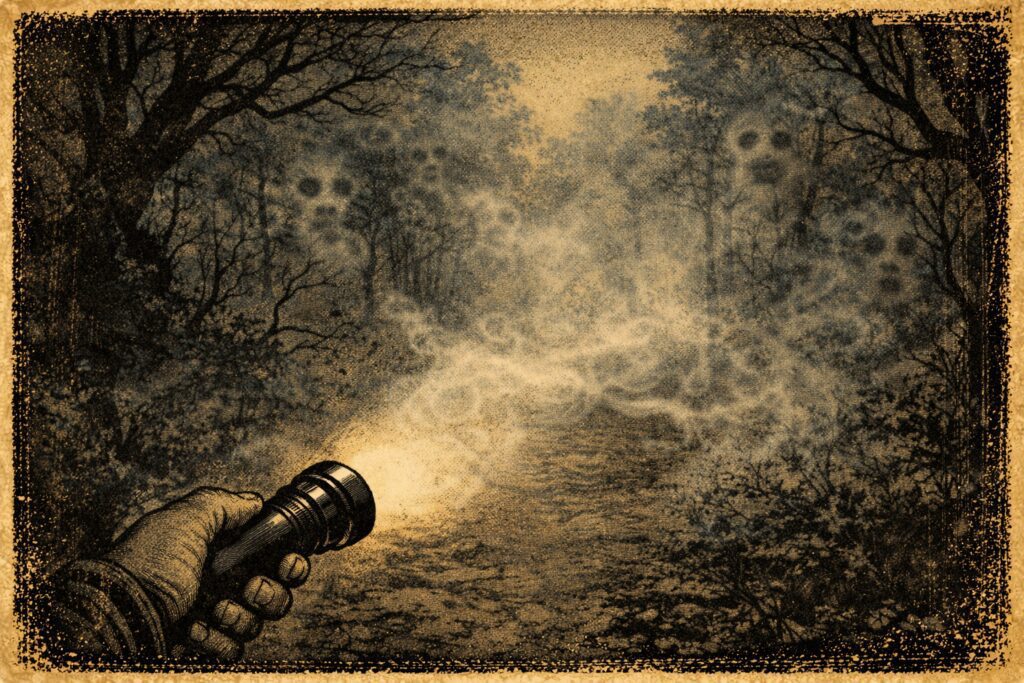
Why do I see faces in mist?
Your brain is wired to find patterns, especially faces. That’s pareidolia, and it’s normal. (PMC)
Final Thoughts On Ghostly Mists
Ghostly mist is one of my favorite “maybe” signs. Because it sits right on the border. Maybe it’s supernatural or maybe it’s just a low hanging cloud in a very spooky place.
If you take one thing from this guide, take this: You do not need to declare a ghost.
You need to collect the cleanest version of that encounter as you can.
Run your tests. Log your conditions. Get a second angle. Then let the evidence speak. Don’t try to rationalize it right away. Just let the data and evidence breathe for minute. Then, compare it to the events that happened at the same time to see if it fits a ghostly pattern.
And if you ever capture a mist clip that climbs the ladder to Grade A, let me know about it, eh?
Do you have ghostly mist image to check out? If so, send me an email through the Contact page, and I’ll check it out.
Thanks for reading Ghostly Activities. Much appreciated and take care!




I was looking up “large mist ball” because I actually saw one, one morning while having a cup of coffee in bed. I have a large wall of windows that looks out to the countryside. My windows are about 8 feet off the ground and this cloud was moving from about 15 feet away (when I first noticed it) towards the corner window, It did move pretty fast, it was totally self contained and about 3-4′ in diameter. It was swirly on the edges, but seemed pretty dense in the middle. Oh, and it was white. The craziest thing is that my cat saw it and ran over and hopped on the back of a the chair by the window where it seemed to disappear below, to get a better look I’m assuming. I just sat there and watched it in disbelief. after it seemed to disappear into the wall, I ran over to that location and it was gone. There was no fog or frost that day. It was just a bright, clear fall morning. I’ve seen things, but this was by far the strangest and the fact that my cat obviously saw it too, makes it even more real to me. I’m usually alone in my experiences so I never have personal validation of what I saw. So, people do see these, or at least one cat and person has.